Britain’s ‘bonkers’ station cats have become the highlight of our miserable railways
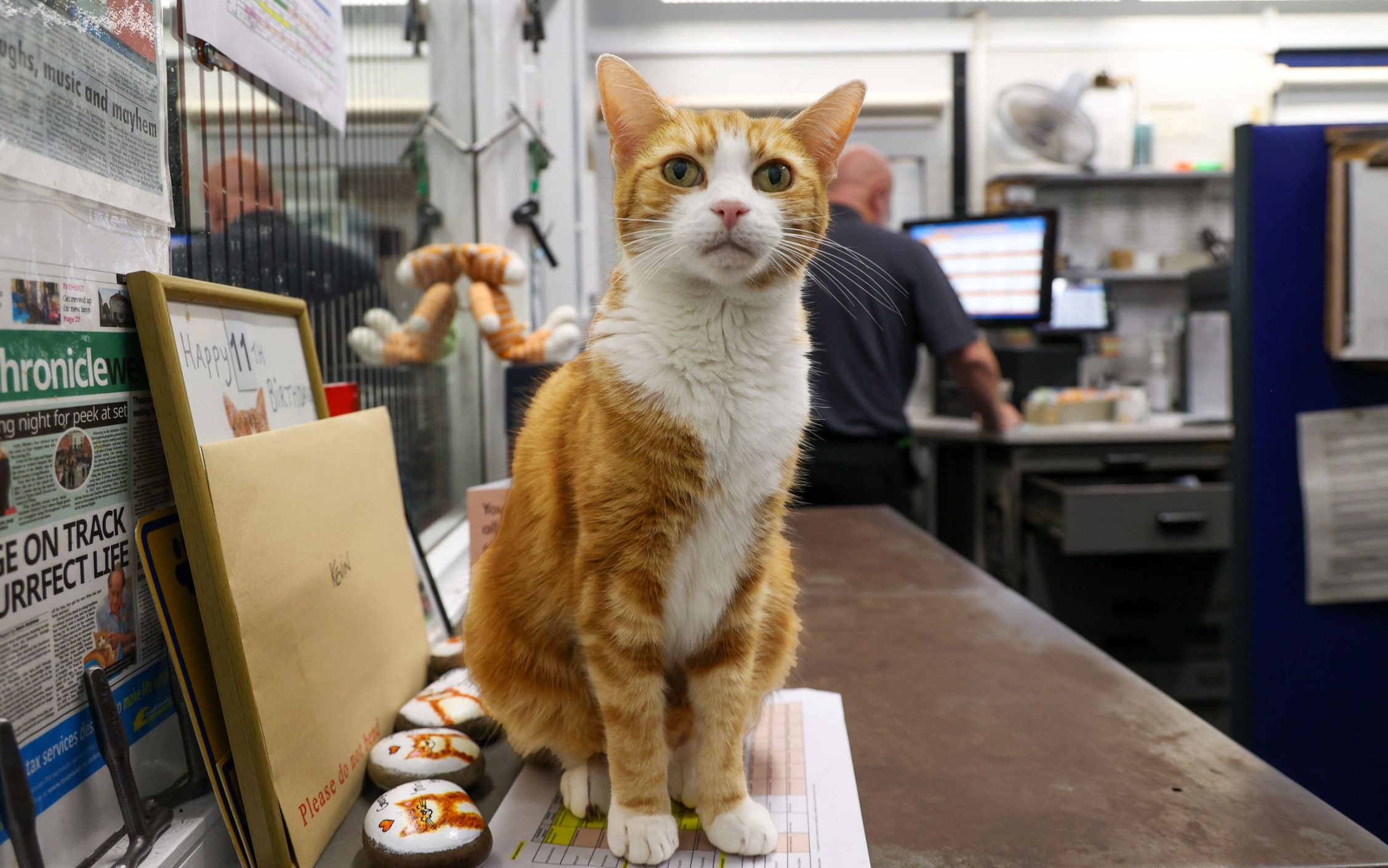
George of Stourbridge Junction even has his own memoir and merchandise for his adoring fans - John Lawrence
It’s a sodden morning at Sutton Coldfield railway station, a few miles outside Birmingham, but at the café on platform two, spirits are being buoyed by a small black cat.
Betty (last name Macchiato) was found, her owner and the café’s proprietor Alex Light reports, in a bin near the station in April last year. Only recently out of kittenhood, she wasn’t in good shape: “She was mangy, full of worms, full of fleas, and she had three kittens with her. She was a proper teenage mum.” Light took her in with a view to feeding her up and getting her well enough to be rehomed. Betty, however, had other ideas, and established herself as the station cat.
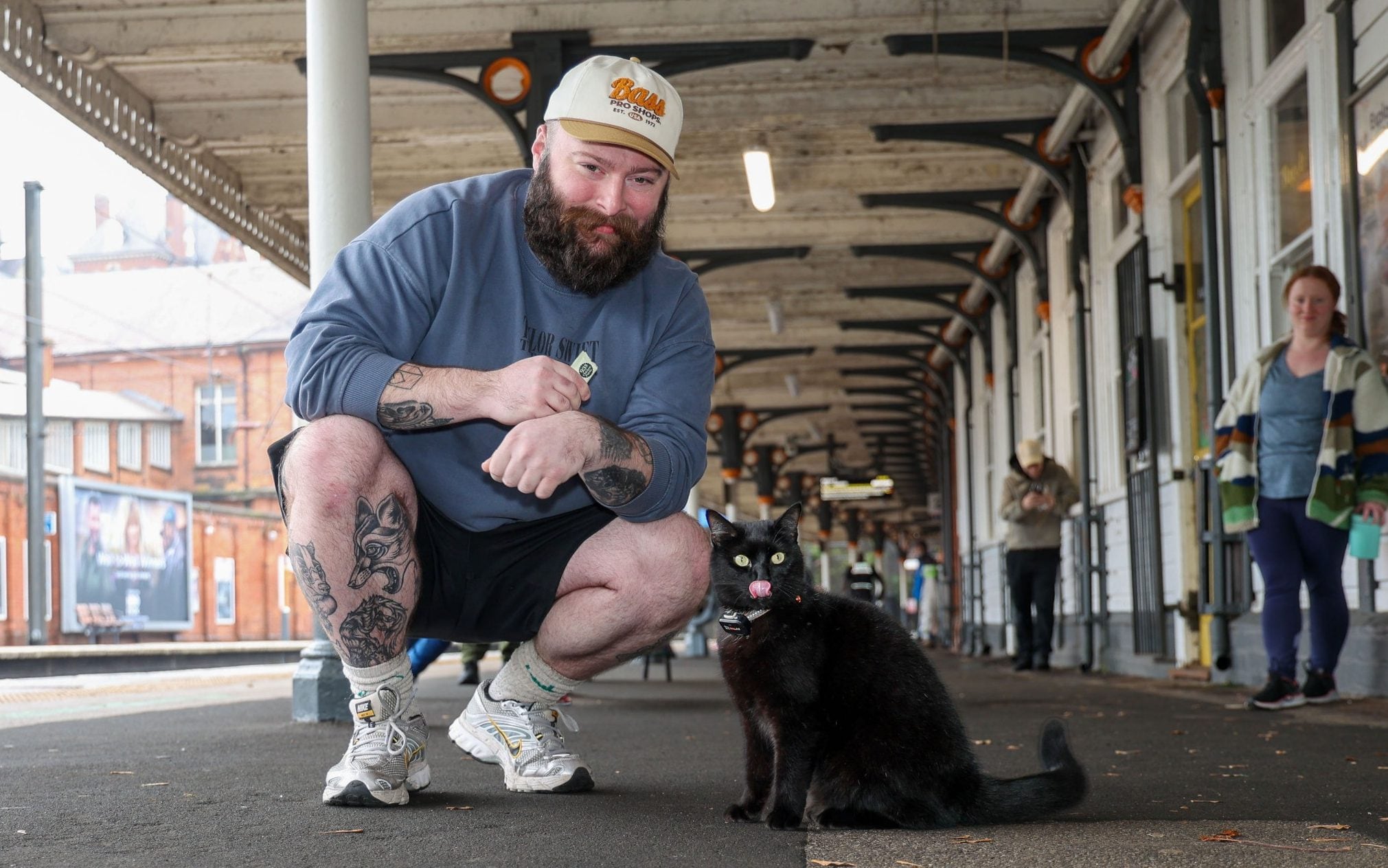
Alex Light with his cat, Betty Macchiato, who has taken it upon herself to become the station cat at Sutton Coldfield Railway Station - John Lawrence
She now rejoices in the title of “Chief mouse catcher of Sutton Coldfield railway station”, and – like any self-respecting modern station cat – has her own Instagram page. Photos on it chart the vagaries of her enviable life: prowling modishly up and down the platform, relaxing in a cardboard box, playing manically with a toy butterfly attached to some string.
Betty isn’t Britain’s only semi-famous station cat. There is also George at nearby Stourbridge Junction, Tiggy in Chester and Barras at Kirkby Stephen East station in Cumbria. A quick glance on social media and it’s easy to see dozens more across the country, many with hundreds, if not thousands of followers. Stourbridge’s George, for instance, has more than a quarter of a million on various platforms, eager to keep abreast of his latest activities.
Britain, in short, has gone a bit nuts for station cats. Quite where the appeal lies is clear, however, after a few minutes in Betty’s company; chatty, witch-black and extraordinarily soft, she is nothing short of a charisma bomb. Some people visit the station just to see her, Light says: one gentleman admirer comes along with a bag of cat treats, sits with her for an hour, then goes back home.
“It is a bit bonkers, how much people are excited to see Betty sometimes,” Light admits. “You get people walking into the cafe, asking if she’s there – and walking right out again if she isn’t.”
“You hear so much about the negative stuff like loneliness at railway stations,” he adds. “They’re associated with bad things and people jumping in front of trains. It’s nice that this is something really positive.”
Quite often, Betty’s behaviour is sufficiently alarming, endearing or bizarre that commuters find themselves breaking that great British taboo of speaking to one another. One of Betty’s favoured tricks, for instance, is to leap down onto the tracks and lick herself. This, Light says, can draw a crowd of concerned onlookers – but those who know Betty’s ways are usually on hand to explain that she will jump back onto the platform when she feels the tracks vibrating. “I think she enjoys the panic people get into,” Light says.
Though clearly a people cat, Betty is less kind to the rodents she kills – she has had to be trained not to bring her victims into the café itself, Light says. She is, however, civil with dogs and is “best friends” with a golden retriever who visits the station every morning. “She gets really happy whenever the golden retriever’s here,” Light reports. “They sit together. It’s so nice.”
Famous though Betty may be locally, she is but a minnow compared to George of Stourbridge Junction, a 12-year-old ginger tom who lives in a private bedroom off the ticket office. When I arrive to meet him, I am expecting to be bowled over – with all his followers on social media, his own memoir (The Autopawography of a Station Cat), a calendar and other merch, he is the Taylor Swift of British station cats. But in the flesh, he is unexpectedly self-effacing – although the ticket office around him is festooned with evidence of his celebrity: photos, treats donated by fans, portraits painted of him by admirers miles away.
George was adopted by Ian “Tommo” Tomlinson, a line supervisor, four or so years ago, after his original owner moved to Spain. His fame has spread so far that people make the pilgrimage from the likes of Japan, America and New Zealand just to meet him. Still, Tomlinson points out, George can be “spiteful” like any cat (he’ll bite and scratch anyone unwise enough to tickle his tummy, for instance).
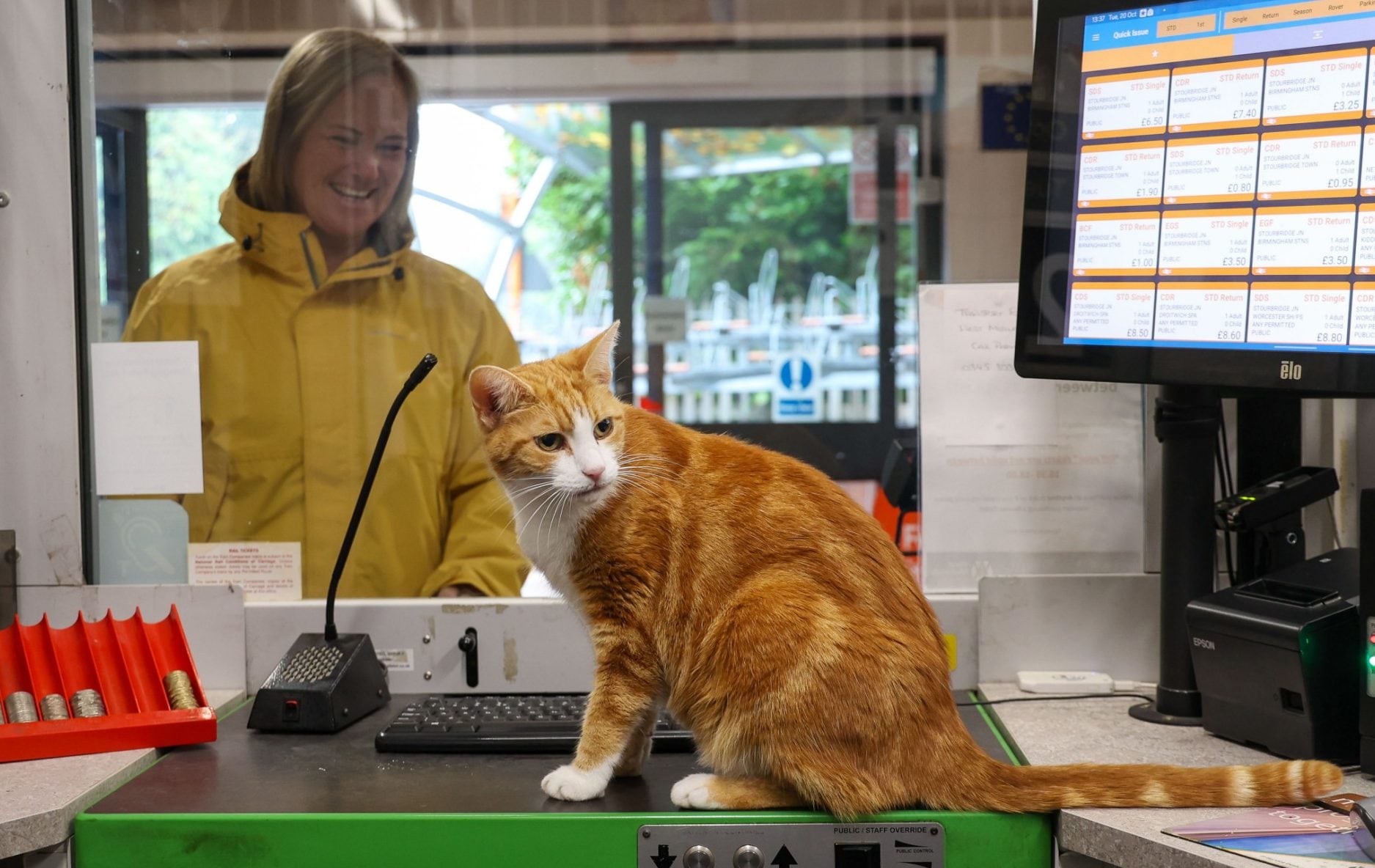
George keeps things running smoothly at Stourbridge Junction Railway Station - John Lawrence
Tomlinson is used by now to the hysteria George produces, but reminds me that it wasn’t so long ago that most railway stations had a resident cat, as they were valued for their ability to keep rodent numbers down. Stationmasters could even claim a “cat allowance” to keep their cats in clover. As stations stopped being manned around the clock, their numbers dwindled.
Up in Chester, local rodents live in terror of Tiggy, a seven-year-old sphynx-and-tabby cross who spends her days in the station but most nights at her owner Katherine Wells’s house nearby. Wells is also in charge of Tiggy’s social media, and regularly posts elaborate stories about the cat that draw on a large cast of supporting characters (Mrs Emmeline Peckhurst, a pigeon; Mr Phileas Moss Esq, a snail; Station Rats A and B).
People like following the stories she writes about Tiggy and her friends, because they’re like a “soap opera” that can be followed day by day, Wells says. And the attraction of station cats more broadly, she believes, lies in the way they brighten what is often a depressing part of people’s lives. “People going through stations are often on their commute, feeling the drudgery of it all, that feeling of ‘Oh I have to go to work again’. But having a beautiful cat there – it really lifts people.”
With community ties feeling weaker than ever, Tiggy and other station cats can bind people briefly together, Wells reckons. “People work different hours, they work from home a lot. You used to get familiar faces at the station, but you don’t these days. But Tiggy is that one familiar face.”
Tiggy is also a regular at the nearby pub – and seems to lift spirits there too. “I had a lovely message recently from a guy who said that Tiggy had been sitting with him, and that he’d been signed off work with depression and that she had really elevated his mood.”
Wells was struck recently by how much people noticed Tiggy’s absence, when she kept her at home for a few days because she’d lost her tracker. She was inundated with messages from people worried about what might have happened to the cat; a stranger even bought her a replacement tracker. “People feel they can be emotional over a cat,” Wells says. “And even if two strangers are just looking at a cat being sweet, rather than talking, that’s a form of connection.”
On station cats’ social media pages, run by their owners or managers, a clear lingua franca has emerged: confessional, emotional, gently – but never dangerously – funny. George, of Stourbridge Junction, has a penchant for the kind of therapy-speak typically seen on mental health posters. “Never feel you have to hide the hurt you carry,” he opines in one recent post. “Life rarely tells us when we’re making a memory,” he observes in another. This stuff is lapped up by George’s fans: “Thank you for the wise words,” is one typical reply.
Elsewhere, memories are being kept alive of cats who have sadly taken the train to the great station in the sky: like Felix, the senior pest controller of Huddersfield station, who died in 2023, and Bolt, his successor, who miaowed his last just weeks ago.
In Stevenage, a crowdfunded, 1.7m-tall bronze statue is being prepared to honour the late, beloved Nala, a frosties-and-milk beauty who became such a popular station stalwart that in 2023, her owner released a charity Christmas single on her behalf (Meow). On Nala’s Facebook page (still very much active, though the cat died nearly a year ago), a clay mock-up of the statue – which is expected to cost some £8,000 – was unveiled last month, showing Nala sitting pertly on a ticket barrier.
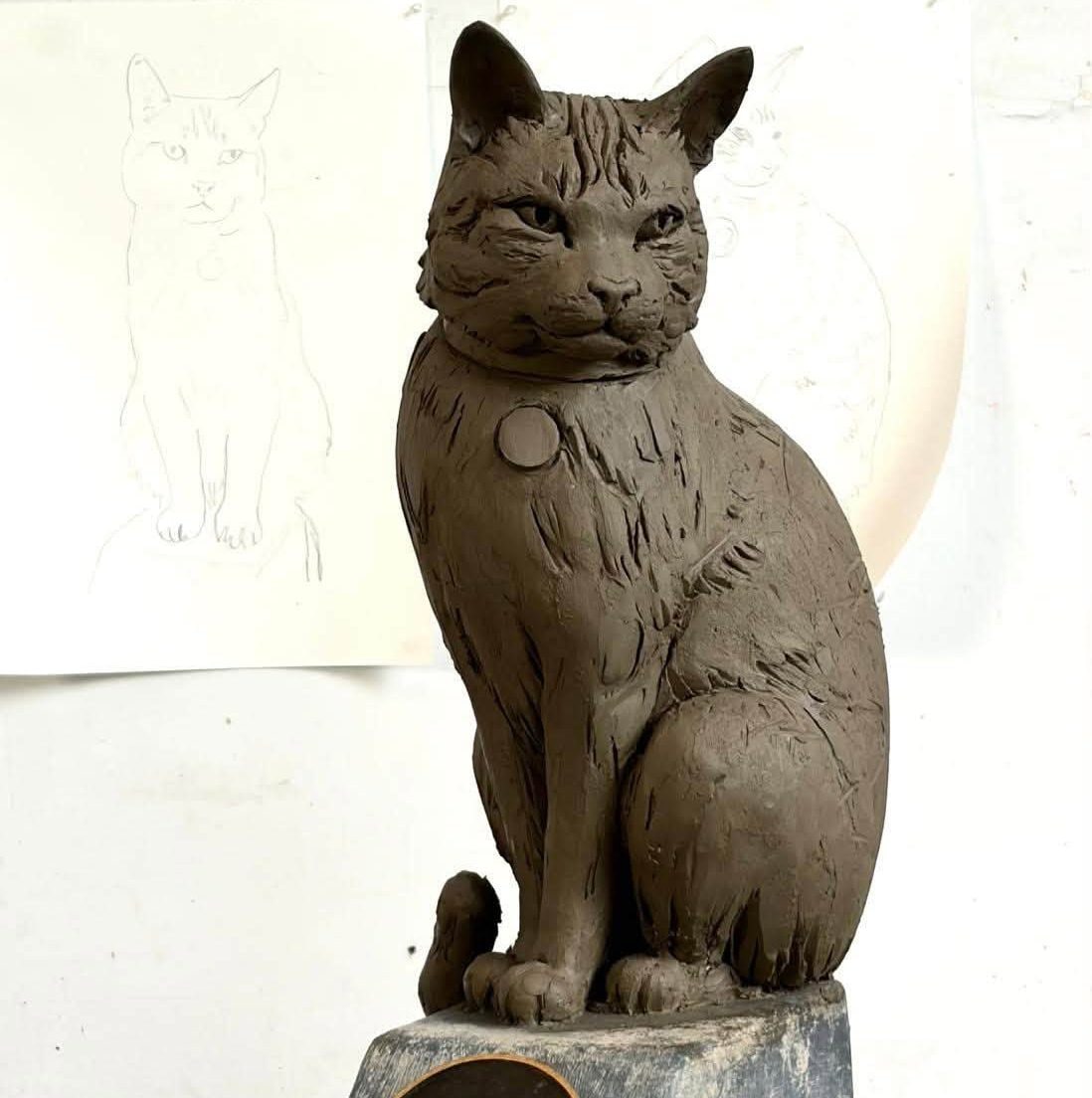
A clay statue of Nala, the former station cat at Stevenage, will be replaced with a more permanent bronze statue
The cheerfully rudimentary mock-up drew outpourings of grief and rapture from the Nala community. “Nala would love it,” one admirer claimed. “Oh gosh, this has made me cry,” said another.
Proof, if any more were needed, that Britain seems unlikely to fall out of love with station cats anytime soon.
Try full access to The Telegraph free today. Unlock their award-winning website and essential news app, plus useful tools and expert guides for your money, health and holidays.
Source: Nature



0 Comments